Well, I think one of my main problems is the insurmountable nature of a full game is making me procrastinate: However, I also been busy lately - so atypically I actually have an excuse this time.
So, I'm thinking I should make a demo. Compress the Brain into one stage, Compress the midsection into one stage, Compress the lower body into one stage. Three bosses, all the game mechanics in one go.
Due to the engine I'm using, I can simply change the stage ordering whenever I want all willy-nilly, so making a demo with intent is not a waste of time by any means; Plus, I get the core programming out of the way which I've been neglecting.
Cytomight
The core moves are as follows: I want left and right walking, jumping, and shifting. Walking is self-explanatory, there's very few games with sessile protagonists. Jumping is where things might take a turn. I originally wanted the hardline Castlevania style "no mistakes" jumping, but it's not fluidic - which is notable since you're playing in fluid.
So, it comes down to shifting. Changing cell permeability to go "gaseous". (not actually gas, but functionally so gamewise). So, once you shift you're ballistic (like Castlevania). This affords challenge since you have to sacrifice agility for safety mid-jump against a perceived hazard. If you pull back early in the jump, you won't have any momentum if you shift - but you might make it back to the original ledge. On the other hand, shifting early while at the highest horizontal speed will carry you a greater distance invincible at the cost of a predictable landing.
Shifting is the main combat mechanic of the game. The idea is to absorb energy and items to move them around or otherwise interact with them. Bullets can be absorbed to fire them back, or digested into ATP. However, while invincible in Gas form - you are sessile, so if you land in an enemy you might have no choice but to take a hit. I'd like to avoid this, I don't want the player to feel Zugzwang'd because of how they landed - so I'll probably add some sort of attack to sessile enemies that damages the Gas form.
Monday, January 27, 2014

Sunday, January 19, 2014
Making Progress
Designed two of the bosses as "proof of learning" for the player to show off they know how to play. Not sure where to put them though.
Ok, like, yes - you know how to jump/fly/shoot now, and the boss should go in the stage it's appropriate for... but should I put it closer to the start or closer to the end? On the one hand putting such challenges early means the player has to master all their tricks early, on the other hand once you complete a learning challenge there's no where else to go but down.
Actually, given the split level design I'm using I should probably place these bosses at the split path junctions so that if the player doesn't catch on they can get reprieve stages without feeling like they lost.
Ok, like, yes - you know how to jump/fly/shoot now, and the boss should go in the stage it's appropriate for... but should I put it closer to the start or closer to the end? On the one hand putting such challenges early means the player has to master all their tricks early, on the other hand once you complete a learning challenge there's no where else to go but down.
Actually, given the split level design I'm using I should probably place these bosses at the split path junctions so that if the player doesn't catch on they can get reprieve stages without feeling like they lost.
Monday, January 13, 2014
Backlog Complete: No Distractions
Granted, some of them I didn't actually finish: But games these days are so start-to-finish homogenous that there's no reason to ever play any of them passed the first few hours.
XCOM for example, I built a few satellites and captured a few aliens - but I legit didn't see it going anywhere.
On the other hand, Final Fantasy 7... while I tend to ignore/skip story, especially on replays (I beat it on console already), I found that the distribution of unusual materia kept combat fresh throughout - and new strategies continually form (Such as Added Effect-Hades, MP Turbo/MP Absorb Contain and the like)
Well, no matter. It's done - yay.
WORK!
I'm drawing pictures of bacteria, paramecia, cilia, phospholipid bilayers... everything. Level design, my weakness!
XCOM for example, I built a few satellites and captured a few aliens - but I legit didn't see it going anywhere.
On the other hand, Final Fantasy 7... while I tend to ignore/skip story, especially on replays (I beat it on console already), I found that the distribution of unusual materia kept combat fresh throughout - and new strategies continually form (Such as Added Effect-Hades, MP Turbo/MP Absorb Contain and the like)
Well, no matter. It's done - yay.
WORK!
I'm drawing pictures of bacteria, paramecia, cilia, phospholipid bilayers... everything. Level design, my weakness!
Saturday, January 11, 2014
Steam Backlog Haunts Me
I drew what must be hundreds of paramecia, bacteria and miscellaneous organic compounds... looking for something that screams protistagonist, but so far nothing.
Ever present is my Steam Backlog... for the first time in three years, I'm under 20 games. In the meanwhile, I'm trying to clear them as expediently as possible.
For example: Fallout New Vegas? Beat it in 4 hours following a cheese guide. Backlog checked, moving on.
Ever present is my Steam Backlog... for the first time in three years, I'm under 20 games. In the meanwhile, I'm trying to clear them as expediently as possible.
For example: Fallout New Vegas? Beat it in 4 hours following a cheese guide. Backlog checked, moving on.
Wednesday, January 1, 2014
2014: The Year of Cytomight
I ran a few online polls to see which project has the most interest. They all tied at zero...
Either way: Unless my health/finances fail completely, my New Years resolution was to finish one of my game projects, and ifnot, to give up game design. Considering I've pumped out 2-day projects before, this is a real test of if I'm still even capable of working anymore.
So, I decided on Cytomight. As much as Flippin' Hell is my game-baby, I'm still lorecrafting for it. Point of No Return could have been a contender, as with the remake to Scattilac, but Cytomight has the most potential to ... be a game.
Here's the design docs so far
Premise: A doctor creates our hero cell "Cytomight", but there is a lab accident and he steps on the phial. After cleaning the cut in his foot (point of entry for Cytomight, the first level), he [doc] gets changed out of his lab clothes into nice dinner wear: He has a planned dinner date.
My original design for the doctor was from one of my Flippin' Hell dwarves, which I named Dr. Stonovan Dvergar.
The chain of events for the dinner date tie into the stage events Cytomight goes through. Dinner happens during the stomach level for example, there's a planned bathroom break, and even a sudden guest appearance by the doctors boss... meanwhile, he's being possessed by demons! Creating life in this manner opened the doors to the underworld, but because Cytomight is only a cell - only reeaaaally tiny demons got in.
Fight demons, cleanse the body, don't undergo phagocytosis... things like that.
Planned Physics: 2D platforming. Originally was going to have fixed angle jumping similar to Castlevania, but I'll probably need a more agile character. Gravity effects might change based on location in the body... well, not "gravity", more like muscle functions and stuff.
Planned Art: The star of the game is the artistic choices I made this time. All the monsters, bosses, items and etc. are based on actual molecules.
Take the most basic enemy, the modal Snake.
Histamine is used in immune response, and to me looks somewhat like a snake. So we have our first monster... "Hisstamine"
One of the more impressive examples was when I found how morphic a lot of organic molecules are. One of my later bosses is planned to be Vitamin B12, which is made from the synthesis of four other molecules (Ring AD and Ring BC / A, B, C, D) or, rather, four smaller enemies. Ring AD looks kinda like a hollow armour, while Ring BC looks like a scythe... well, in my imagination at least....
I'll even take it up a level and allow monsters to drop the molecule they're based on to complete a sort of miniature "MoleDex"
In addition, I few cellular NPCs - as well as the player character, are based more on complete bacteria - just not sure what yet.
Stage Planning:
The game is divided into three discrete zones. The Lower Body, The Upper Body and The Brain. I have branching paths throughout the game so the easiest way to break it down is that the Lower Body is before you can make choices, then you path through the Upper Body, and then unite in The Brain for the finale.
In a rather wimpy pun: Stage difficulty will be sorted by tissue "hardness". The easier path will be through the main muscles/organs, while the harder path leads up the skeletal areas (which is a more "direct" path to the brain).
I have The Brain pretty well figured out: It's made of 3 Final Stages, with one of two preceding stages. We'll call these stages 10 (Finale), 9 (Middle), 8 (Beginning of End), 7a and 7b (Two Stages of Brain Entry). In my notes, these stages are planned as 10. Frontal Lobe, 9. Parietal Lobe, 8. Occipetal Lobe, 7a. Temporal Lobe, 7b. Cerebellum.
The Upper Body (Trunk) is a little messier... literally. There's 3 unique stages you play through here depending on your path. I have them labeled 4ab, 5ab and 6abc (6c is a secret area). I have to cover getting from the pelvic area up to the brain stem in three short stages. The stages range from the guts, stomach, lungs, heart and esophagus on the soft tissue side and the hip/pelvis/sacrum, lumbar/spine/ribs and finally the Skull as the "hardest possible stage"... I included a special stage 6c, The Medullapons (bad portmanteau, but meh) as a "bail out" if the player cannot rise to the challenge to beat the Skull.
The Lower Body is the simplest, but oddly where I don't know exactly how to split them up. I would have liked to have had 3 stages (1, 2 and 3), but since the Lower Body basically is just a skelemuscular trip from the toe to the upper leg ball/socket joint... I don't think 3 whole stages is warranted. So, instead, I'm started with Stage 1 - The Toe, ending somewhere between the ankle to the knee. There's also Stage 3, ending with the ball/socket joint to the hip... So where's Stage 2? In my original draft I was using Castlevania 3 as a model - and its Stage 2 is also "missing" (Clocktower). People don't exactly have a clock sticking out ... in that area, so I'll probably excise it from the game and shift all the stages down a number. Alternatively, I'll add a "fast-track" warp or hard mode entrance somewhere in Stage 1 that gets you farther in the game - This would turn Stage 2 into a "3b". Well, ignore the odd numbering - I'll give them actual numbers later.
So, that's where I left off:
What do I want the player to experience?
Personally, I find organic chemistry fascinating - all them different reactions and stuff, the citric acid cycle, immune response/cytokines, etc... but meanwhile, found a plethora of puns buried deep in the human (dwarven?) body. There's no need to give stages and enemies cool, clever names because the Greek have done it for me already (well, ok - 19th century scientists using Greek nomenclature)
It's a strange coincidence that "Cystine", in my imagination, does like the image of God/Adam in the Sistine Chapel, touching together at a single Sulfur bond...
Acetone Peroxide is a dangerous explosive, its Dimer legitimately looks like a cartoon bomb.
Diethyl Ether looks like a bat, Ribose looks like people...
Metaldehyde look like a submarine mine... its primary use is to kill slugs... guess what we're having for dinner!
Using clever imagery and semi-accurate representations of organic functions combined with informative "MoleDex" entries, I want the player to get as wrapped up in the "human experience" as I did.
Well, that's it for now: Time to start cracking.
Either way: Unless my health/finances fail completely, my New Years resolution was to finish one of my game projects, and ifnot, to give up game design. Considering I've pumped out 2-day projects before, this is a real test of if I'm still even capable of working anymore.
So, I decided on Cytomight. As much as Flippin' Hell is my game-baby, I'm still lorecrafting for it. Point of No Return could have been a contender, as with the remake to Scattilac, but Cytomight has the most potential to ... be a game.
Here's the design docs so far
Premise: A doctor creates our hero cell "Cytomight", but there is a lab accident and he steps on the phial. After cleaning the cut in his foot (point of entry for Cytomight, the first level), he [doc] gets changed out of his lab clothes into nice dinner wear: He has a planned dinner date.
My original design for the doctor was from one of my Flippin' Hell dwarves, which I named Dr. Stonovan Dvergar.
The chain of events for the dinner date tie into the stage events Cytomight goes through. Dinner happens during the stomach level for example, there's a planned bathroom break, and even a sudden guest appearance by the doctors boss... meanwhile, he's being possessed by demons! Creating life in this manner opened the doors to the underworld, but because Cytomight is only a cell - only reeaaaally tiny demons got in.
Fight demons, cleanse the body, don't undergo phagocytosis... things like that.
Planned Physics: 2D platforming. Originally was going to have fixed angle jumping similar to Castlevania, but I'll probably need a more agile character. Gravity effects might change based on location in the body... well, not "gravity", more like muscle functions and stuff.
Planned Art: The star of the game is the artistic choices I made this time. All the monsters, bosses, items and etc. are based on actual molecules.
Take the most basic enemy, the modal Snake.
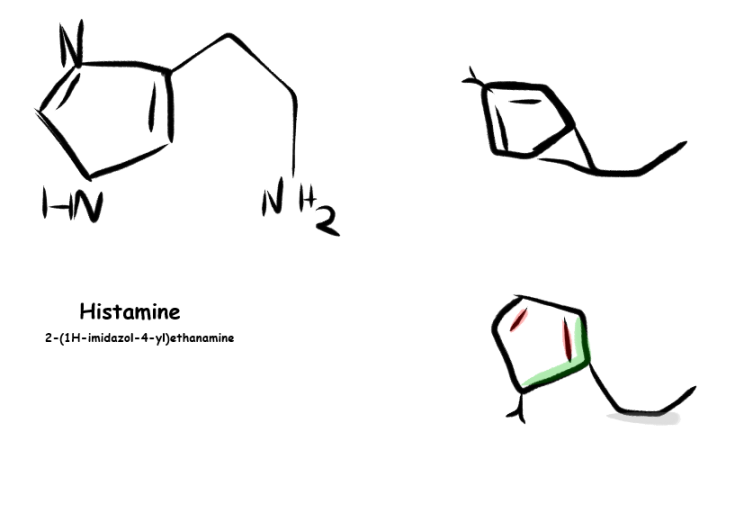 |
| Hisstamine |
Histamine is used in immune response, and to me looks somewhat like a snake. So we have our first monster... "Hisstamine"
One of the more impressive examples was when I found how morphic a lot of organic molecules are. One of my later bosses is planned to be Vitamin B12, which is made from the synthesis of four other molecules (Ring AD and Ring BC / A, B, C, D) or, rather, four smaller enemies. Ring AD looks kinda like a hollow armour, while Ring BC looks like a scythe... well, in my imagination at least....
I'll even take it up a level and allow monsters to drop the molecule they're based on to complete a sort of miniature "MoleDex"
In addition, I few cellular NPCs - as well as the player character, are based more on complete bacteria - just not sure what yet.
Stage Planning:
The game is divided into three discrete zones. The Lower Body, The Upper Body and The Brain. I have branching paths throughout the game so the easiest way to break it down is that the Lower Body is before you can make choices, then you path through the Upper Body, and then unite in The Brain for the finale.
In a rather wimpy pun: Stage difficulty will be sorted by tissue "hardness". The easier path will be through the main muscles/organs, while the harder path leads up the skeletal areas (which is a more "direct" path to the brain).
I have The Brain pretty well figured out: It's made of 3 Final Stages, with one of two preceding stages. We'll call these stages 10 (Finale), 9 (Middle), 8 (Beginning of End), 7a and 7b (Two Stages of Brain Entry). In my notes, these stages are planned as 10. Frontal Lobe, 9. Parietal Lobe, 8. Occipetal Lobe, 7a. Temporal Lobe, 7b. Cerebellum.
The Upper Body (Trunk) is a little messier... literally. There's 3 unique stages you play through here depending on your path. I have them labeled 4ab, 5ab and 6abc (6c is a secret area). I have to cover getting from the pelvic area up to the brain stem in three short stages. The stages range from the guts, stomach, lungs, heart and esophagus on the soft tissue side and the hip/pelvis/sacrum, lumbar/spine/ribs and finally the Skull as the "hardest possible stage"... I included a special stage 6c, The Medullapons (bad portmanteau, but meh) as a "bail out" if the player cannot rise to the challenge to beat the Skull.
The Lower Body is the simplest, but oddly where I don't know exactly how to split them up. I would have liked to have had 3 stages (1, 2 and 3), but since the Lower Body basically is just a skelemuscular trip from the toe to the upper leg ball/socket joint... I don't think 3 whole stages is warranted. So, instead, I'm started with Stage 1 - The Toe, ending somewhere between the ankle to the knee. There's also Stage 3, ending with the ball/socket joint to the hip... So where's Stage 2? In my original draft I was using Castlevania 3 as a model - and its Stage 2 is also "missing" (Clocktower). People don't exactly have a clock sticking out ... in that area, so I'll probably excise it from the game and shift all the stages down a number. Alternatively, I'll add a "fast-track" warp or hard mode entrance somewhere in Stage 1 that gets you farther in the game - This would turn Stage 2 into a "3b". Well, ignore the odd numbering - I'll give them actual numbers later.
So, that's where I left off:
What do I want the player to experience?
Personally, I find organic chemistry fascinating - all them different reactions and stuff, the citric acid cycle, immune response/cytokines, etc... but meanwhile, found a plethora of puns buried deep in the human (dwarven?) body. There's no need to give stages and enemies cool, clever names because the Greek have done it for me already (well, ok - 19th century scientists using Greek nomenclature)
It's a strange coincidence that "Cystine", in my imagination, does like the image of God/Adam in the Sistine Chapel, touching together at a single Sulfur bond...
Acetone Peroxide is a dangerous explosive, its Dimer legitimately looks like a cartoon bomb.
Diethyl Ether looks like a bat, Ribose looks like people...
Metaldehyde look like a submarine mine... its primary use is to kill slugs... guess what we're having for dinner!
Using clever imagery and semi-accurate representations of organic functions combined with informative "MoleDex" entries, I want the player to get as wrapped up in the "human experience" as I did.
Well, that's it for now: Time to start cracking.
Subscribe to:
Comments (Atom)